Squat for life, because strength starts from the ground up and helps you get up from the ground
Why Squats Matter More During Perimenopause and Menopause
For many women, the menopause transition is a wake-up call for strength. As estrogen declines, the body becomes more vulnerable to loss of muscle mass and loss of bone density. Strength training is one of the most effective tools we have to protect long-term health, and squats are one of the most valuable exercises you can learn and keep for life. Resistance training has been shown to improve bone mineral density in postmenopausal women, especially when programs are progressive and appropriately loaded.
Why squats are a big deal for women in midlife
Squats train the muscles and patterns that support real life:
Getting up from a chair or the floor
Carrying groceries and lifting kids or grandkids
Climbing stairs
Maintaining balance and independence
They also build strong legs and hips, which matter for fall prevention and confidence as we age. High-intensity resistance training programs in postmenopausal women have improved bone strength measures and physical function when properly supervised.
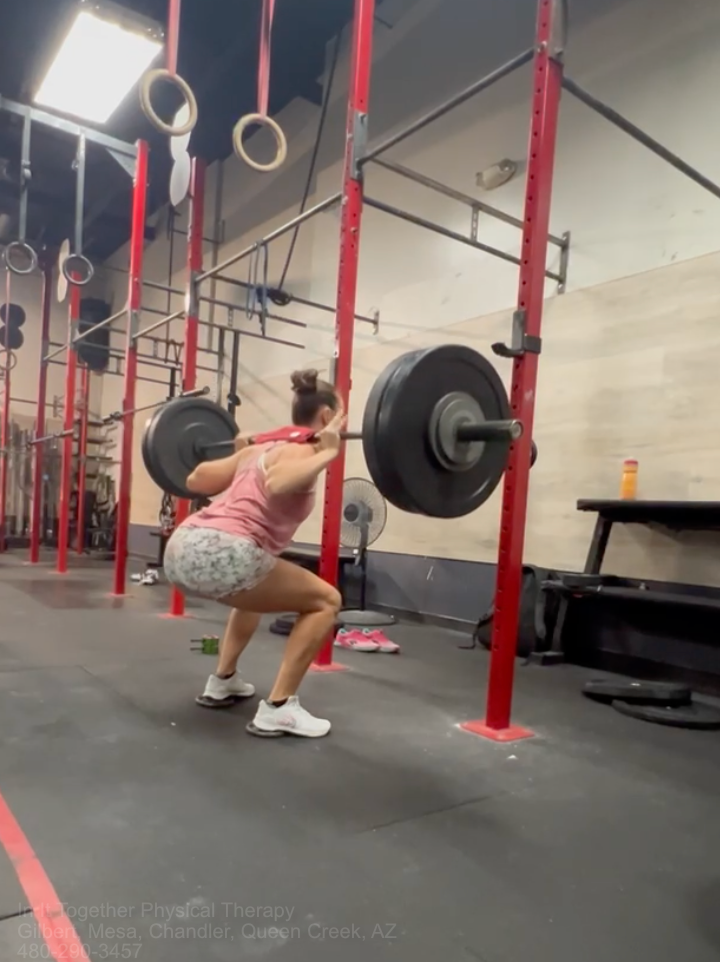
Owner and PT Kristen getting her squat on
Bone health and the spine
A well-coached squat can strengthen the hips, thighs, and trunk, which helps support a strong spine. Bone responds to loading. When we progressively load tissues, we send a signal to maintain or build bone and muscle. That is one reason resistance training is recommended for older adults, including for bone health and function.
Is squatting below parallel safe
For most people, deep squats are not inherently dangerous. The key is appropriate loading, good technique, and a build-up that matches your current mobility and strength. Research has looked closely at knee mechanics at different squat depths and does not support the blanket idea that deeper squats are automatically harmful.
That said, the “best depth” is the depth you can control well without sharp pain, compensation, or loss of balance. Below parallel can be a great goal, but it is not a requirement on day one.
Different bodies, different squat mechanics
There is no single perfect squat that fits everyone. Body proportions change how squats look:
Longer femurs often mean a bit more forward torso angle
Hip structure can change how wide your stance feels best
Ankle mobility affects depth and knee travel
Foot shape and balance affect how you load the squat
Two women can squat equally well with different stance widths and different torso angles. Good form is less about looking identical and more about being stable, controlled, and repeatable.
How a PT helps you squat with less pain and more confidence
A physical therapist can help you keep the benefits while reducing barriers like pain, stiffness, or fear of re-injury. Common PT strategies include:
Modifying depth, stance, or tempo
Using a box squat, goblet squat, or heel elevation as a bridge
Addressing ankle, hip, or thoracic mobility limits
Strengthening around irritated knees, hips, or low back
Coaching breathing and bracing for a stronger, safer spine
If you are navigating perimenopause or menopause and want a plan that builds strength, supports bone health, and respects your body, squats can be a cornerstone. With the right progression and coaching, they are one of the most powerful “functional skills” you can invest in for the decades ahead.
Key Research Citations
Resistance Training, Menopause, and Bone Health
Watson SL et al. (2018)
Heavy resistance training is safe and improves bone, function, and stature in postmenopausal women with low bone mass.
Osteoporosis International, 29(11), 2537–2544.
https://pubmed.ncbi.nlm.nih.gov/30003334/Howe TE et al. (2011)
Exercise for preventing and treating osteoporosis in postmenopausal women.
Cochrane Database of Systematic Reviews.
https://pubmed.ncbi.nlm.nih.gov/21735429/Layne JE & Nelson ME (1999)
The effects of progressive resistance training on bone density.
Sports Medicine, 27(1), 1–16.
https://pubmed.ncbi.nlm.nih.gov/10028130/
Squat Depth, Knee Safety, and Joint Health
Hartmann H et al. (2013)
Analysis of the load on the knee joint and vertebral column with changes in squat depth.
Sports Medicine, 43(10), 993–1008.
https://pubmed.ncbi.nlm.nih.gov/23821469/Schoenfeld BJ (2010)
Squatting kinematics and kinetics and their application to exercise performance.
Journal of Strength and Conditioning Research, 24(12), 3497–3506.
https://pubmed.ncbi.nlm.nih.gov/21157399/
Individual Anatomy and Movement Variability
McKean MR et al. (2010)
Biomechanical comparison of back and front squats.
Journal of Strength and Conditioning Research, 24(6), 1571–1579.
https://pubmed.ncbi.nlm.nih.gov/20555292/Escamilla RF et al. (2001)
Biomechanics of the squat exercise.
Medicine & Science in Sports & Exercise, 33(1), 127–141.
https://pubmed.ncbi.nlm.nih.gov/11194113/
Spine Health, Functional Strength, and Aging
Fragala MS et al. (2019)
Resistance training for older adults: position statement.
Journal of Strength and Conditioning Research, 33(8), 2019–2052.
https://pubmed.ncbi.nlm.nih.gov/31343601/Liu CJ & Latham NK (2009)
Progressive resistance strength training for improving physical function in older adults.
Cochrane Database of Systematic Reviews.
https://pubmed.ncbi.nlm.nih.gov/19160203/
Role of Physical Therapy in Strength Training
American Physical Therapy Association (APTA)
Role of physical therapists in strength training and injury prevention.
https://www.choosept.com